Good Thursday to you my “Walking with Jesus” friends,
Have you ever been at the ocean shoreline long enough to watch the tide go in or out? Or have you watched a major change in public opinion, in a very short period of time? Today, let’s join Paul and Barnabas as they experience a rapid tidal wave change of opinion among a group of people and it almost cost them their lives!

Yesterday we left Paul and Barnabas in the city of Perga, the capital city of the coastal province of Pamphylia, in modern day Turkey. They had just arrived from their successful several weeks on the Island of Cyprus. Soon after their arrival here in Perga they were stunned by the departure of John Mark, their traveling helper, who abandoned them to return to Jerusalem.
Dr. Luke, the author of the book of Acts, does not tell us how long Paul and Barnabas remained in Perga, nor what they experienced there. Luke’s next words, in his log of this journey, are: “From Perga they went on to Pisidian Antioch.” (Acts 13:14)
While Luke does not give us any details of this leg of their journey, most likely they headed straight north, stopping in the small towns and villages along the way where they might find hospitality from Jews. Hospitality to fellow Jews who were traveling was a high value in Jewish society in those days. I imagine if Paul identified himself as having been a Pharisee from Jerusalem, they would have been welcomed into any Jewish home. I assume any home which hosted Paul and Barnabas heard the story of Jesus and how Jesus had changed their lives.
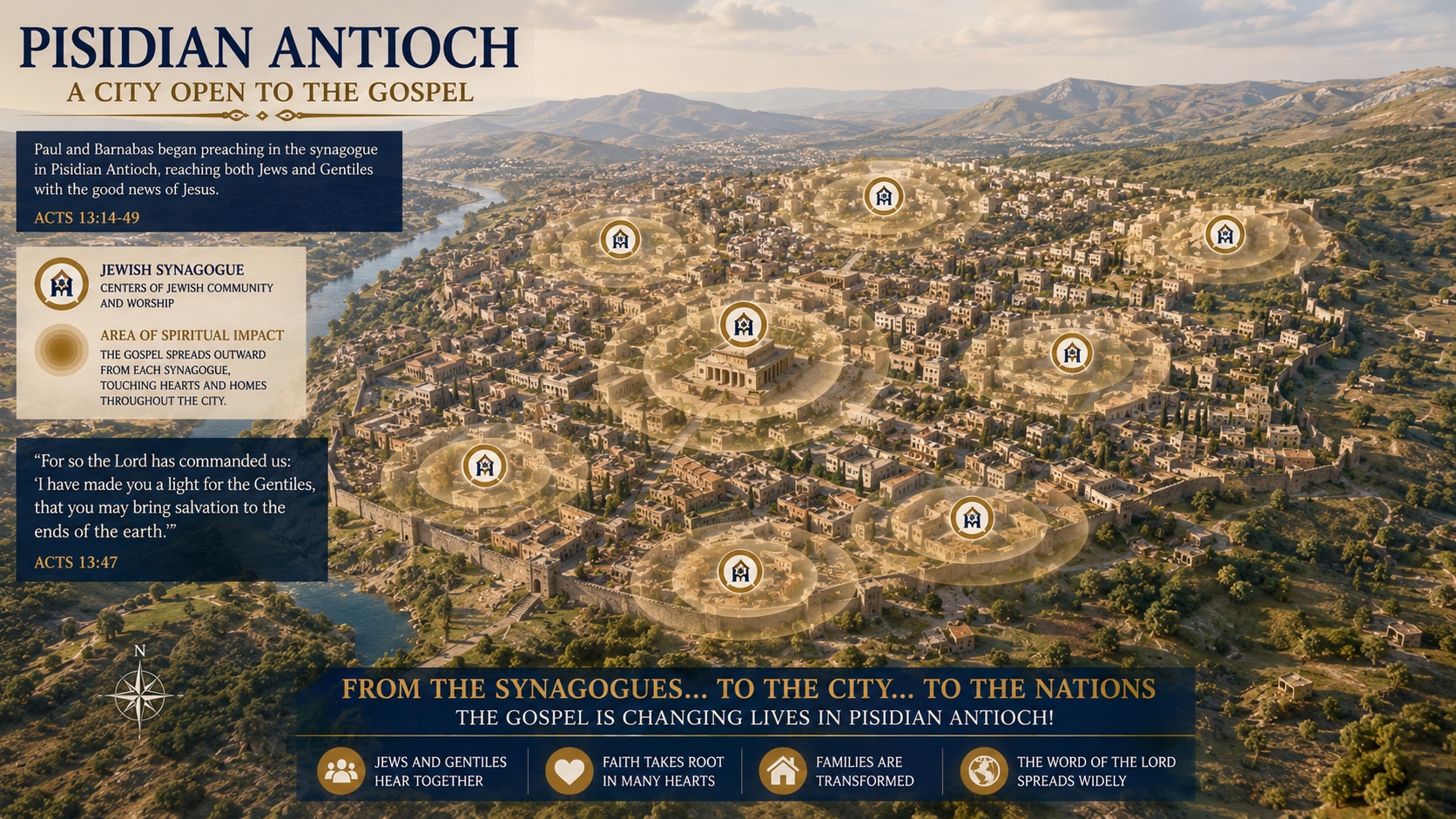
Many cities in the Roman empire had the name Antioch, so let’s not confuse Pisidian Antioch, where Paul and Barnabas next arrived, with Syrian Antioch, where they had been first commissioned to this missionary journey. Pisidian Antioch, as the name suggests, was in the province of Pisidia, and was about 100 miles north of Perga.
The road they walked would have been a steady uphill climb into the highlands area of the province of Pisidia. Luke tells us: “On the Sabbath, Paul and Barnabas entered the synagogue and sat down. After the reading of the Law and the Prophets, the leaders of this synagogue asked them, ‘Brothers, if you have a word of exhortation for the people, please speak.” (Acts 13:14,15)
Pause, take a close look. In one brief sentence Dr. Luke gives remarkable insight into how the Jewish synagogues of Paul’s day functioned and I believe it’s another reason WHY that specific era in human history is the time God chose for Jesus to come to earth as our Redeemer. Do you see it?
First… Paul and Barnabas simply walked right in and sat down, without any fear that even though unknown they might not be allowed in.
Synagogues, while intended for Jews, were wide open to ANYONE, particularly men, who wanted to know the God of Israel. Question: is your church open to anyone interested in knowing the one true God?
Second... The Scriptures were read, both the Law, which would have been the first five books of the Bible known as the Pentateuch, and the Prophets, which we know include both the major prophets like Isaiah, Jeremiah, Ezekiel and Daniel, and the small ones like Hosea, Joel, Amos, and Haggai.
Question: Is the Bible, the Word of God, highly revered in your church and read frequently and openly with respect?
The Jewish tradition is that EVERY Synagogue in the world reads the same Scriptures on any particular Sabbath. Let’s remember that Paul, a well-trained Pharisee, had memorized huge portions of God’s Word, and probably knew by heart which reading they would hear that particular Sabbath.
Third... did you notice that the leaders of that synagogue asked their visitors, Paul and Barnabas, if they had a word of exhortation that they wanted to share? That’s significant.
A ‘word of exhortation’ means it would have been a word of theological explanation or practical application of the Scriptures read that day. Also, it would be assumed whatever was spoken would be God honoring and fully in alignment with God’s Word and finally would be encouraging.
Question: When the people of your church gather together, is there ever an opportunity for someone other than the pastor to share a word they have received from the Holy Spirit in their study of God’s Word or their journey with Jesus?
Paul knew this was normal practice in every synagogue across the Roman empire in the first century, thus I’m sure Paul came that day fully prepared for the moment he knew he would be asked if he had a word of exhortation? Dr. Luke says Paul stood up and began with these words: “Fellow Israelites and you Gentiles who worship God, listen to me…” (Acts 13:16) And with that brief call to attention, Paul preached a powerful sermon which required 25 verses for Luke to record it!
I urge you to read it my friends, for Paul did a masterful job of doing what Jesus had done with the two men on the road to Emmaus on resurrection Sunday, remember? (Luke 24:27) Paul used the Scriptures they had read, added others, and gave a very clear presentation of Jesus as the God sent Messiah and Savior of the world, whom all Jews were waiting for.
Amazed, the people of this Pisidian Antioch synagogue invited Paul and Barnabas to come back the next Sabbath and tell them more about these things. Acts 13:44 reports: “The next Sabbath almost the whole city gathered to hear the word of the Lord.” That, my friends, is evidence of the work of the Holy Spirit of God stirring a spiritual appetite in that city.
Have you seen that happen in your city? Are there people regularly coming to your church hungry to hear the good news about Jesus?

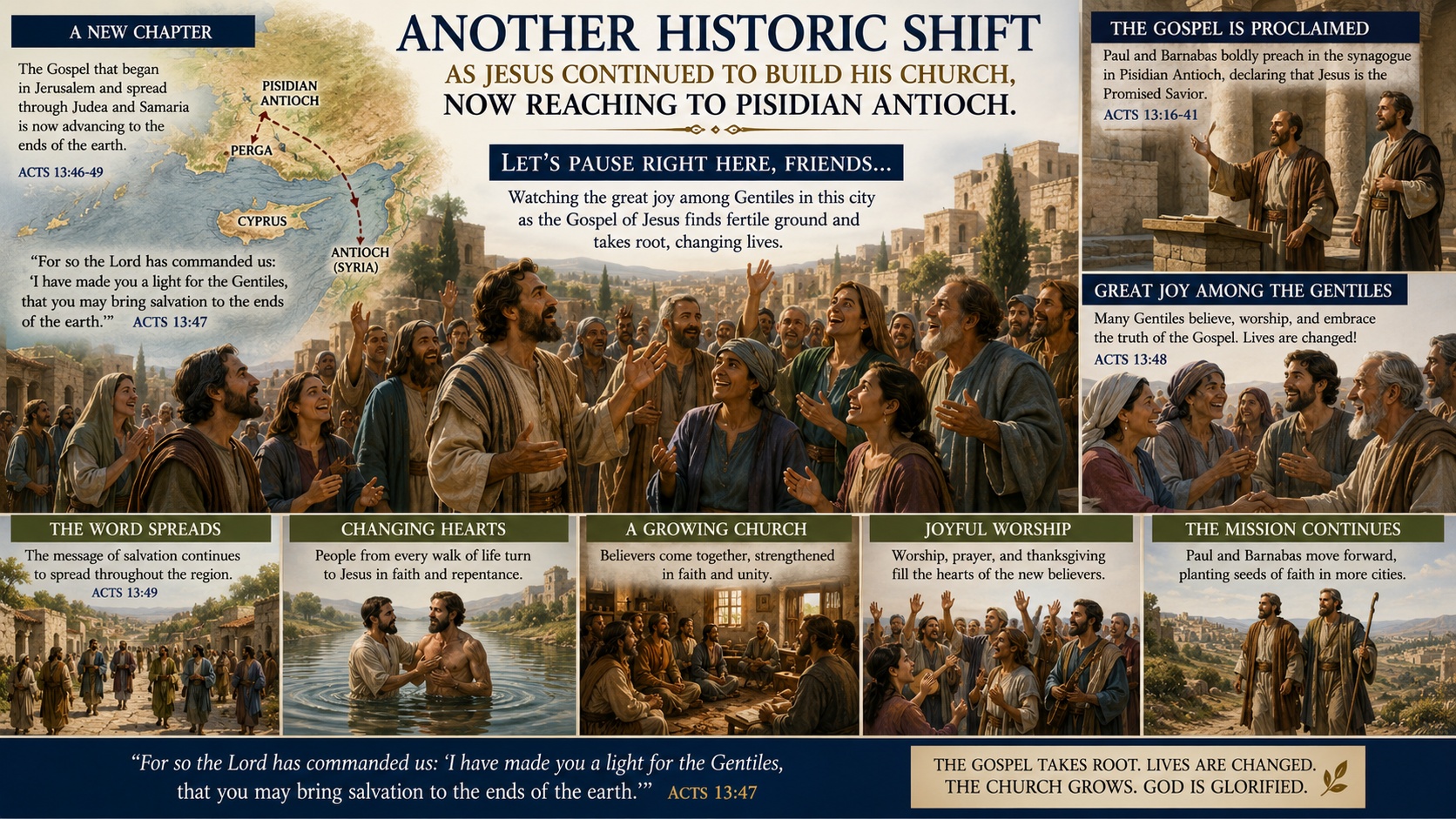
Sadly, when the Holy Spirit is working the dark kingdom is also working and Acts 13:44-48 reports some jealous Jews tried to turn the spiritually hungry crowd against Paul by contradicting what he was teaching them about Jesus. Finally, Paul made this profound statement: “We had to speak the word of God to you [Jews] first. Since you reject it and do not consider yourselves worthy of eternal life, we now turn to the Gentiles. For this is what the Lord has commanded us: ‘I have made you a light for the Gentiles, that you may bring salvation to the ends of the earth.“ (Acts 13:46,47)
Oh my! I doubt any of us can imagine how that sounded either to the Jews or the Gentiles of Pisidian Antioch! To the Jews it was condemnation and to the Gentiles a welcome invitation from God. This is another historic shift in the story of what happened as Jesus continued to build His church now reaching to Pisidian Antioch.
Let’s pause right here friends, watching the great joy among Gentiles in this city as the Gospel of Jesus finds fertile ground and takes root, changing lives. Sadly, opposition continued, and we’ll look at that tomorrow. For today, is the Gospel finding fertile ground in your city?
The ‘lessons learned’ notes below will again help you dig more deeply into God’s Word and the song I’ve found will draw you into wonderful worship. And let’s meet here in Pisidian Antioch again tomorrow.
Today’s Scripture: Acts 13:14-48.
Choose below to read or listen.
 |  |
Bible images provided with attribution to www.LumoProject.com.
Have a comment or question about today’s chapter? I’m ready to hear from you, contact me here.

Pastor Doug Anderson
“Let us run with perseverance the race marked out for us, with our eyes fixed on Jesus…” (Heb. 12:1,2)
Archived back issues of “Walking with Jesus” and other resources are available by clicking here to open our ‘home page’ (or go to HOME at upper right of this page).
Share with friends. Subscribe below for daily “Walking with Jesus”.