
Good Monday to you my “Walking with Jesus” friends,
Most people tend to live life on a very superficial level. By that I mean most people resist pushing too deeply into anything, perhaps for fear they won’t like what they find or perhaps because they don’t want to invest the time and effort to get down to the root, the foundational issues. Superficial relationships, superficial spirituality, superficial morals, superficial parenting etc. Of course, the dysfunctional results of superficial living are evident all around us, aren’t they?
The past few days we’ve spent an extended time with Jesus and a crowd of people digging deeply into one of Jesus’ most controversial teachings. In fact, John who was an eyewitness writes this: “From that time on many of His followers turned back and no longer followed Jesus.” (John 6:66)
Today, let’s take a close look at this controversial situation to see the important truths God wants us to learn. Jesus had claimed “I am the bread of life.” (John 6:35,48,51) Jesus was comparing Himself to the manna which fell from heaven each morning keeping 1 million Hebrew slaves alive in the desert for 40 years. (Exodus 16) Yesterday, I explained that Jesus was describing the eternal significance of what He was going to accomplish in His death on the cross, as He would give His body as a sacrifice in payment for the sins of all people. (John 6:50,51)
Now Jesus continued with even more controversy by saying: “Very truly I tell you, unless you eat the flesh of the Son of Man and drink His blood, you have no life in you. Whoever eats My flesh and drinks My blood has eternal life and I will raise them up at the last day. For My flesh is real food and my blood is real drink. Whoever eats My flesh and drinks My blood remains in Me and I in them. Just as the living Father sent Me and I live because of the Father, so the one who feeds on Me will live because of Me… Whoever feeds on this bread will live forever.” (John 6:53-58)
Oh my, that’s challenging, isn’t it? What did Jesus mean?
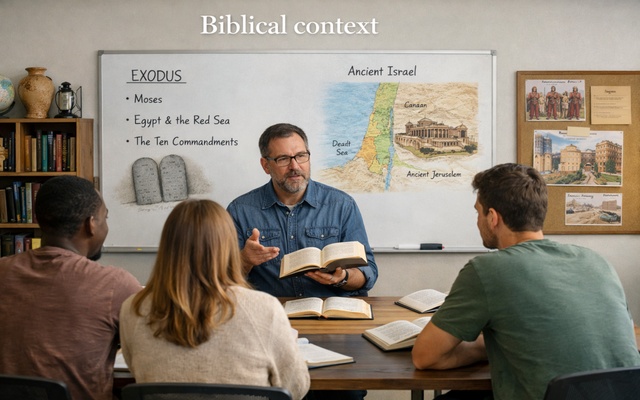
One of the very important principles we need to practice when reading the Bible is discerning when/how to distinguish between factual, literal, historical statements and parables or metaphors or spiritual statements. We have a great advantage over those people standing there that day listening to Jesus. What advantage?
For them, they could not possibly imagine what we know as the centerpiece of the purpose for which Jesus came to earth… Passover/Easter weekend. For us, the facts, the details of what Jesus accomplished that Passover/Easter weekend give very powerful, truthful realism and explanation to these otherwise barbaric words of Jesus recorded in John 6.
Taken literally, those words of Jesus in John 6 seem to be promoting cannibalism. Of course that is NOT what Jesus meant. At no time did anyone take a bite of Jesus’ flesh or drink His blood. But remember, this was a Jewish crowd, and they fully understood the God prescribed Jewish sacrificial system which required many blood sacrifices of lambs at the Temple. Often after the sacrifice, the lamb was cooked and eaten. Do you recall that was an important part of the original Passover evening experience in Egypt? (Ex. 12:1-14)
Do you remember Jesus gave His life as the ultimate sacrificial Lamb on Passover weekend? But while Jesus’ body was sacrificed on the cross and He died, Jesus’ body was not cooked and eaten, like the Passover lamb. Instead, Jesus’ dead body was buried and on the third day was miraculously raised by God the Father so Jesus could be the living, victorious over death Savior, giving eternal life to anyone who placed their full trust in what Jesus’ death accomplished by paying their sin condemnation price with God, earning their forgiveness and eternal life!
But there is one other very important aspect to this moment, especially for the 12 disciples standing there listening to Jesus. A few months later, in the upper room in Jerusalem, only hours before He would go to the cross, Jesus took bread from the Passover meal, broke it and gave it to His disciples instructing them to eat it.
Matthew was there and he records it this way: “Jesus took the bread, and when He had given thanks, He broke it and gave it to His disciples saying, ‘Take and eat, this is my body.“ (Matt. 26:26) Now obviously it was NOT Jesus’ flesh, it was the Passover bread. But hours later, as Jesus was brutalized and crucified and the wrath of God was poured out upon our sin which Jesus bore upon Him on the cross, Jesus took upon Himself, the sin punishment we all deserve. (Isaiah 53:4-7,10-12)
In the Passover meal as Jews ate the bread it was symbolic of their profound gratitude to God for sparing them as the Passover lamb had given its life so they could be spared by the angel of death passing over them. Eating the Passover bread was a fresh expression of their faith in God, as their ancestors had done by their act of killing the lamb and placing its blood on their house door frame was an act of great faith in God.
Faith that God would be true to His promises… an angel of death would come over Egypt and that angel would see the blood and would spare them because they had taken faith-action in obedience to God’s instructions.
So, Jesus was showing His disciples that it would be this same faith in God’s promise that Jesus’ death would earn their deliverance from God’s judgment upon them for their sin as God accepted Jesus’ death as payment in full for their sin.
As they ate the bread and a few moments later drank the wine, which Jesus handed them that evening, they were declaring their faith in God’s promise for their deliverance because of Jesus’ sacrifice on their behalf. Do you understand it my friends? The bread represented Jesus’ flesh, the wine represented Jesus’ blood, sacrificed for God’s forgiveness of their sins and ours!
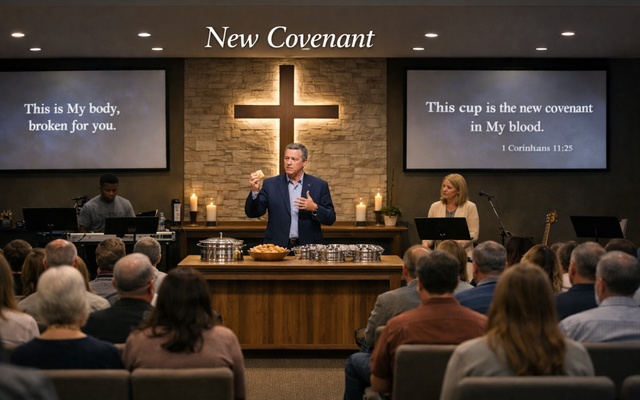
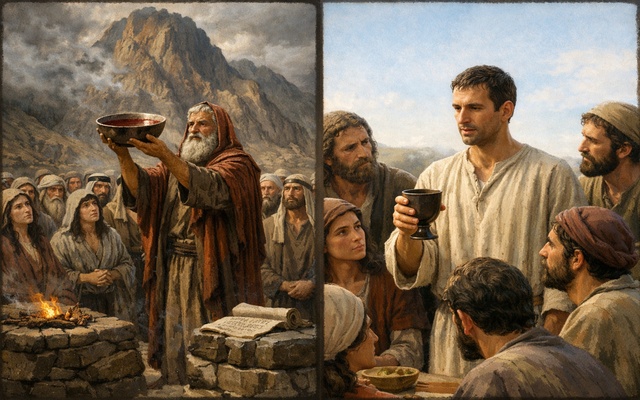
In fact, Matthew records that Jesus said, as He gave them the cup that upper room evening: “Drink from it all of you. This is My blood of the covenant, which is poured out for many, for the forgiveness of sins.” (Matt. 26:27) Oh, they understood, for Moses has sprinkled the lamb’s blood on the people as they first entered into Covenant with God at Mount Sinai! (Exodus 24:7,8) Now Jesus was declaring it was HIS shed blood, not a lamb’s, which would be accepted by God the Father as payment for sin and establishment of a new covenant between God and each repentant person!
Oh my friends, do you understand the significance of the words of Jesus spoken in John 6 when viewed through the upper room Passover experience of Jesus and His disciples just before the cross, as recorded in Matthew 26? We need to pause here making sure we understand and yes there’s yet more and we’ll look at that tomorrow.
For today, I again urge you to re-read John 6:53-58 & Matthew 26:26-28 asking the Holy Spirit of God to help you fully understand. Of course, the “lessons learned” notes will be helpful, and the worship song will bless your soul, and I’ll be here waiting for you tomorrow.
Today’s Scripture: John 6:53-58 & Matt. 26:26-28.
Choose below to read or listen.
John 6:53-58
 |  |
Matt. 26:26-28
| |
Bible images provided with attribution to www.LumoProject.com.
Have a comment or question about today’s chapter? I’m ready to hear from you, contact me here.

Pastor Doug Anderson
“Let us run with perseverance the race marked out for us, with our eyes fixed on Jesus…” (Heb. 12:1,2)
Archived back issues of “Walking with Jesus” and other resources are available by clicking here to open our ‘home page’ (or go to HOME at upper right of this page).
Share with friends. Subscribe below for daily “Walking with Jesus”.