
LESSONS LEARNED
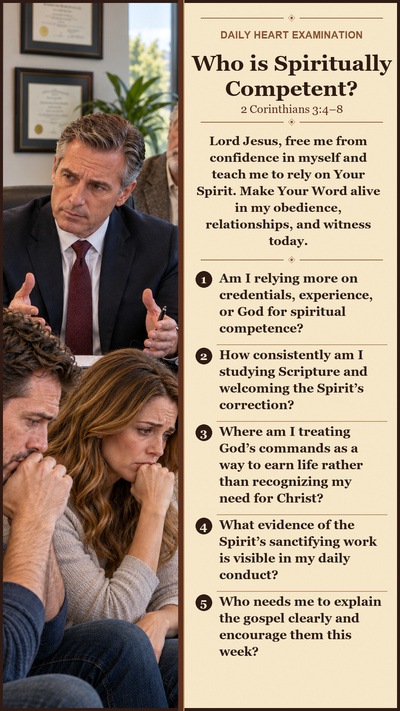
Monday, October 19, 2026 — Who is Spiritually Competent? (2 Corinthians 3:4–8). Paul teaches that genuine spiritual competence comes from God: the written law exposes sin, while the new-covenant ministry of the Holy Spirit gives life through Jesus Christ.
WATCH OUTS
- Credentials cannot replace the Spirit. Paul identifies God, not academic prestige, as the source of spiritual sufficiency (2 Cor. 3:5–6; Zech. 4:6; 1 Cor. 2:4–5).
- Nostalgia can blind us to new-covenant privilege. Paul contrasts the passing glory associated with Moses with the greater ministry of the Spirit (2 Cor. 3:7–8; Heb. 8:6–13; Heb. 12:18–24).
- God’s commands expose rather than cure sin. The law reveals our need for salvation; sin’s wages are death (Rom. 6:23; Rom. 3:20; Gal. 3:21–24).
SUCCESSES / SPIRITUAL GROWTH
- Dependence on God produces spiritual usefulness. Confidence through Christ is confidence in God’s provision (2 Cor. 3:4–5; John 15:5; 1 Cor. 15:10).
- Scripture studied with humility cultivates discernment. Receive the apostolic teaching and ask the Holy Spirit to shape your understanding (2 Cor. 3:6; Acts 17:11; 1 Cor. 2:12–14).
- New-covenant life should show visible transformation. The Spirit gives life, with conduct increasingly reflecting God’s character (2 Cor. 3:6–8; 2 Cor. 3:18; Gal. 5:22–23).
LEADERSHIP DYNAMICS
- Spiritual leaders must refuse self-sufficiency. Paul does not ground ministry authority in impressive credentials alone (2 Cor. 3:5; 1 Cor. 2:1–5; 1 Pet. 5:5–6).
- Competent teaching communicates Christ’s gospel accurately. Do not confuse the condemning function of the law with the life offered in Christ (2 Cor. 3:6–8; Gal. 3:10–14; Rom. 8:1–4).
- Equipping others is a leadership responsibility. Help families and communities understand Scripture rather than merely admire a teacher (2 Tim. 2:2; Eph. 4:11–13; Deut. 6:6–7).
EKKLESIA PERSPECTIVE
- The church is a Spirit-dependent community. Its ministry is not sustained by institutional prestige alone (2 Cor. 3:5–6; 1 Cor. 12:4–7; Zech. 4:6).
- The church proclaims the hope of the new covenant. The good news is forgiveness and life in Christ rather than mere condemnation (2 Cor. 3:6; Luke 22:20; Heb. 9:14–15).
- The church should display God’s glory through changed lives. The greater ministry of the Spirit calls for communal holiness and joyful witness (2 Cor. 3:8; 2 Cor. 3:18; 1 Pet. 2:9–12).