
“What Price is TOO Much?” (Rom. 3:22-25)
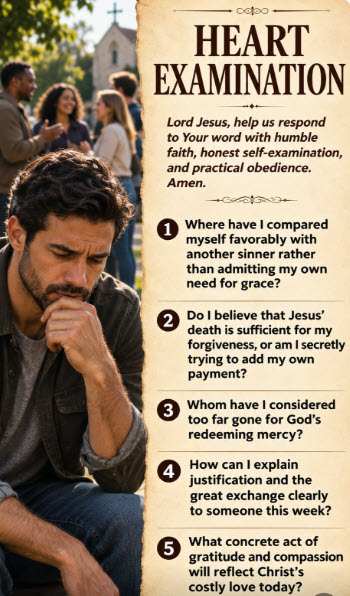
Scroll down for “Lessons Learned…”
What if you stood before God’s judgment seat today and discovered that all your goodness, generosity, and religious devotion could not erase a single sin?
That is the sobering reality Paul reveals in Romans 3: every person stands guilty before a holy God, yet Jesus Christ paid the ransom we could never afford and offers us the priceless gift of justification through faith in Him.
These 12 principles challenge us to abandon self-righteousness, celebrate Christ’s finished work, extend His grace to every kind of sinner, and build a church where the cross—not human achievement—is our greatest treasure.
WATCH OUTS
- Never treat moral respectability as a substitute for redemption. Romans 3:22–23 places every person under the same verdict of sin; comparison with others cannot erase guilt.
Scripture:
Romans 3:23;
Isaiah 64:6;
Ephesians 2:8-9. - Do not confuse costly redemption with something we can purchase. Forgiveness is offered freely through Christ’s sacrifice, not family background, charitable giving, or spiritual effort (Rom. 3:24–25).
Scripture:
Romans 3:24;
1 Peter 1:18-19;
Titus 3:5. - Do not measure a person’s worthiness by the depth of bondage. The outwardly religious person and the openly addicted person share the same need for grace (Rom. 3:23; 6:23).
Scripture:
Romans 3:23;
Luke 18:9-14;
1 Corinthians 6:11.
SUCCESSES / SPIRITUAL GROWTH
- Receive justification as God’s gracious declaration rather than a personal achievement. Pastor Doug explains the legal language of Romans 3:24 alongside the great exchange in 2 Corinthians 5:21.
Scripture:
Romans 3:24;
2 Corinthians 5:21;
Romans 5:1. - Thank Jesus for paying a ransom beyond human capacity. His sacrificial death is presented as sufficient for humanity, calling for grateful faith (Rom. 3:24–25).
Scripture:
Mark 10:45;
1 Peter 1:18-19;
Hebrews 9:12. - Let the equal need of all sinners deepen humility. Faith in God’s grace rules out boasting and nurtures compassion (Rom. 3:23–24).
Scripture:
Romans 3:23-24;
Ephesians 2:8-9;
Titus 3:3-5.
LEADERSHIP DYNAMICS
- Teach both the universality of sin and the sufficiency of Christ. A clear gospel presentation must not conceal either side of Paul’s argument (Rom. 3:22–25).
Scripture:
Romans 3:23-25;
1 Corinthians 15:3-4;
Hebrews 7:25. - Speak of justification in words ordinary listeners understand. Explain forgiveness, a verdict of no guilt, and credited righteousness carefully (Rom. 3:24; 2 Cor. 5:21).
Scripture:
Romans 5:1;
Romans 8:1;
2 Corinthians 5:21. - Avoid ranking those who need pastoral care. Different struggles may require different discipleship support, while every person comes to Christ on the same basis of grace (Rom. 3:23–25).
Scripture:
James 2:1;
Galatians 6:1-2;
Romans 3:22-24.
EKKLESIA PERSPECTIVE
- Build a fellowship where no social class receives a superior gospel. The same need and same Redeemer apply to Jew and Gentile (Rom. 3:22–24).
Scripture:
Romans 3:22-24;
Galatians 3:28;
Ephesians 2:14. - Make room for testimony of deep deliverance without glamorizing sin. A church should celebrate Christ’s work and help people walk in freedom (Rom. 6:23).
Scripture:
1 Corinthians 6:11;
Psalm 107:2;
Romans 6:22. - Center congregational gratitude on the cross rather than human merit. Corporate worship and teaching should continually return to the costly gift of Jesus (Rom. 3:24–25).
Scripture:
Galatians 6:14;
1 Corinthians 1:29-31;
Revelation 5:9-12.