
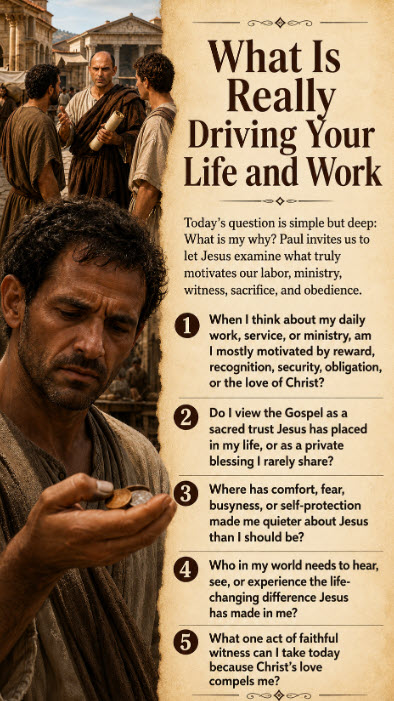
LESSONS LEARNED
Today’s lesson asks every worker, servant, leader, and Jesus-rescued believer to examine the deeper reason behind their labor and witness. Paul shows us that gospel ministry is not a platform for boasting, bargaining, or self-advancement; it is a sacred trust compelled by the love, sacrifice, resurrection, and Lordship of Jesus Christ.
WATCH OUTS
- Do not measure your life only by job title, income, recognition, comfort, or earthly reward; Paul forces us to ask the deeper question of why we work and serve (1 Corinthians 9:16-18).
- Do not turn gospel service into a reason for boasting, because Paul said he could not boast when preaching what Jesus had entrusted to him (1 Corinthians 9:16).
- Do not confuse compulsion by Christ’s love with pressure from guilt, ambition, religious performance, or human approval (2 Corinthians 5:14-15).
SUCCESSES / SPIRITUAL GROWTH
- Let Christ’s love become the controlling motive beneath your work, ministry, generosity, conversations, decisions, and witness (2 Corinthians 5:14).
- Receive your daily responsibilities as opportunities to honor Jesus rather than merely obligations to survive or tasks to complete (Colossians 3:23-24).
- Remember that Jesus loved rebellious sinners enough to come, suffer, die, and rise again; that truth should humble your heart and energize your obedience (John 3:16; 2 Corinthians 5:15).
LEADERSHIP DYNAMICS
- God-honoring leaders help people examine motive, not merely performance, because the why beneath the work shapes the spirit of the work (1 Corinthians 9:16).
- Faithful spiritual leaders resist using ministry as a stage for self-promotion and instead steward influence as a trust from Jesus (1 Corinthians 9:17).
- Mature leaders distinguish between external pressure and holy compulsion, helping people serve from Christ’s love rather than fear, guilt, or applause (2 Corinthians 5:14).
EKKLESIA PERSPECTIVE
- The Church should help believers bring work, retirement, ministry, service, and ambition under the deeper question of purpose before Jesus (1 Corinthians 9:16-18).
- A local body of believers should celebrate gospel witness as a sacred trust carried by the whole people of God, not only by pastors, teachers, or missionaries (1 Peter 2:9).
- The Ekklesia should model lives compelled by Christ’s love in a world often driven by contracts, bargaining, compensation, platform, and personal advantage (2 Corinthians 5:14-15).