
“Treasures in Jars of Clay?” (2 Cor. 4:7-10)
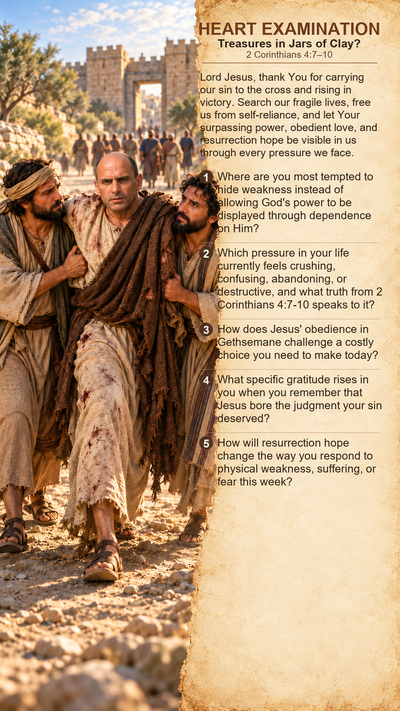
Scroll down for “Lessons Learned…”
LESSONS LEARNED
Friday, October 23, 2026 – “Treasures in Jars of Clay?” (2 Corinthians 4:7-10). Paul teaches that fragile human lives can display God’s surpassing power. Pressure, persecution, bodily weakness, the cross, and resurrection hope become a living witness that Jesus sustains, transforms, and will finally raise His people.
WATCH OUTS
- Human weakness must not be mistaken for spiritual failure. Paul’s jar-of-clay picture teaches that frailty can display God’s power when believers depend on Him rather than hide their limitations. (2 Corinthians 4:7; 2 Corinthians 12:9-10; Psalm 103:14).
- Adversity can tempt us to interpret pressure as abandonment. Paul distinguishes being hard pressed, perplexed, persecuted, and struck down from being crushed, despairing, abandoned, or destroyed. (2 Corinthians 4:8-9; Romans 8:35-39; Hebrews 13:5-6).
- Self-reliance obscures the source of spiritual power. When believers claim credit for endurance or transformation, they hide the truth that the surpassing power belongs to God. (2 Corinthians 4:7; John 15:5; 1 Corinthians 1:27-29).
SUCCESSES / SPIRITUAL GROWTH
- God places priceless treasure within ordinary people. Through faith in Jesus and the indwelling Holy Spirit, fragile human lives become living displays of God’s transforming presence. (2 Corinthians 4:7; Romans 8:9-11; Ephesians 3:16-17).
- Christ’s power sustains believers through severe pressure. God does not promise the absence of hardship, but He supplies courage and endurance that keep suffering from having the final word. (2 Corinthians 4:8-9; Philippians 4:12-13; Isaiah 40:29-31).
- Resurrection hope changes how believers face bodily weakness. Every ache and loss can point forward to the promised transformation into an imperishable, glorified body like Christ’s. (2 Corinthians 4:10; 1 Corinthians 15:42-44; Philippians 3:20-21).
LEADERSHIP DYNAMICS
- Faithful leaders display God’s power without pretending to be invulnerable. Honest weakness and steady dependence on Christ give people a truthful picture of grace rather than a performance of self-sufficiency. (2 Corinthians 4:7; 2 Corinthians 12:9; 1 Peter 5:5-6).
- Resilient leadership interprets hardship through Christ’s presence. Paul names painful realities plainly while also testifying that opposition cannot cancel God’s sustaining work or mission. (2 Corinthians 4:8-9; Acts 20:22-24; 2 Timothy 4:16-18).
- Jesus’ obedience defines the leader’s daily choices. Christ’s submission in Gethsemane calls leaders to choose what honors the Father even when obedience is costly. (Luke 22:42-44; Philippians 2:5-8; Hebrews 5:7-9).
EKKLESIA PERSPECTIVE
- The church is a community of fragile vessels carrying one treasure. Different ages, abilities, and circumstances can reveal the same life of Christ and the same surpassing power of God. (2 Corinthians 4:7; 1 Corinthians 12:12-14; Ephesians 4:4-6).
- Shared suffering can become a corporate witness to Christ. When believers support one another under pressure, the congregation demonstrates that persecution, confusion, and pain do not destroy Gospel hope. (2 Corinthians 4:8-10; Galatians 6:2; Hebrews 10:32-35).
- The church proclaims both the cross and the resurrection. Christian witness remembers Jesus’ costly death, celebrates His bodily victory, and lives in anticipation of resurrection transformation. (2 Corinthians 4:10; 1 Corinthians 15:3-4; 1 Peter 1:3-5).