
LESSONS LEARNED
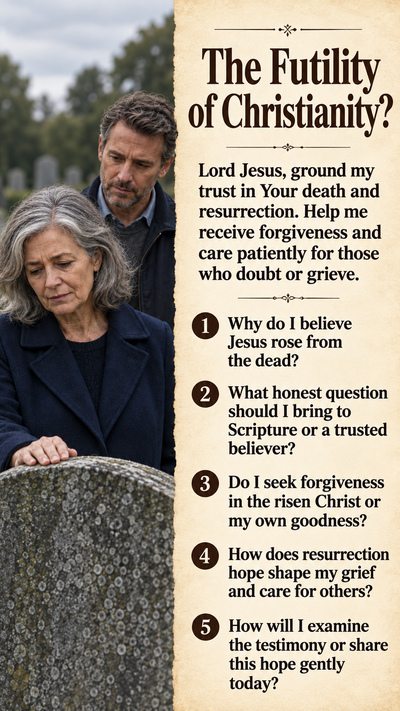
Wednesday September 30, 2026 — The Futility of Christianity? (1 Corinthians 15:12–19). Paul asks us to face the consequences if Christ has not been raised. Faith, forgiveness, and hope beyond death depend on the truth of His resurrection. Follow the argument honestly, keeping its “if” in view as the lesson leads to its final question: What if the resurrection of Jesus is true?
WATCH OUTS
- Do not treat resurrection as an optional addition to Christianity; denying it undermines the gospel’s proclamation and the faith built upon it (1 Corinthians 15:12–17; Romans 10:9).
- Do not confuse a comforting belief with a true one. Examine the apostolic testimony instead of making either personal experience or personal preference the final test (1 Corinthians 15:5–8; John 20:29–31).
- Do not quote Paul’s disastrous consequences as his final conclusion. His argument says what follows IF Christ has not been raised; he goes on to affirm that Christ has been raised (1 Corinthians 15:17–20; 1 Peter 1:3).
SUCCESSES / SPIRITUAL GROWTH
- Bring honest questions into the light and seek a reasoned understanding of the hope you confess, with humility toward people who are still asking (1 Corinthians 15:12–15; 1 Peter 3:15–16).
- Connect forgiveness to the crucified and risen Jesus. Christian assurance rests on His saving work, rather than on the strength of your feelings (1 Corinthians 15:17; Romans 4:25; Romans 8:34).
- Let resurrection hope shape how you face bereavement: acknowledge real grief while trusting God’s promise concerning those who belong to Christ (1 Corinthians 15:18–20; 1 Thessalonians 4:13–18).
LEADERSHIP DYNAMICS
- Address foundational doubts directly and patiently. Help listeners follow Scripture’s reasoning instead of treating their questions as disloyalty (1 Corinthians 15:12–19; 2 Timothy 2:24–25).
- Distinguish eyewitness testimony, biblical teaching, historical inference, and your own illustrations. A leader’s confidence never gives permission to claim more than the evidence supports (1 Corinthians 15:5–8, 15; Luke 1:1–4).
- Teach the consequences of denying resurrection without abandoning the hearer in despair. Keep the conditional argument clear and point toward the risen Christ’s living hope (1 Corinthians 15:19–20; 1 Peter 1:3–5).
EKKLESIA PERSPECTIVE
- Keep the risen Jesus at the center of the church’s shared message. A community built only on helpful advice cannot replace the apostolic gospel (1 Corinthians 15:14–15; Acts 4:33).
- Make room for careful questions across generations. Read the testimony together and practice gracious conversation with those who have not yet heard or believed (John 20:30–31; Colossians 4:5–6).
- Support grieving people with presence, practical care, and resurrection hope. Do not rush their sorrow or reduce comfort to a slogan (1 Thessalonians 4:13–18; Romans 12:15; Galatians 6:2).