
“Purpose in Pain?” (Romans 5:3-10)
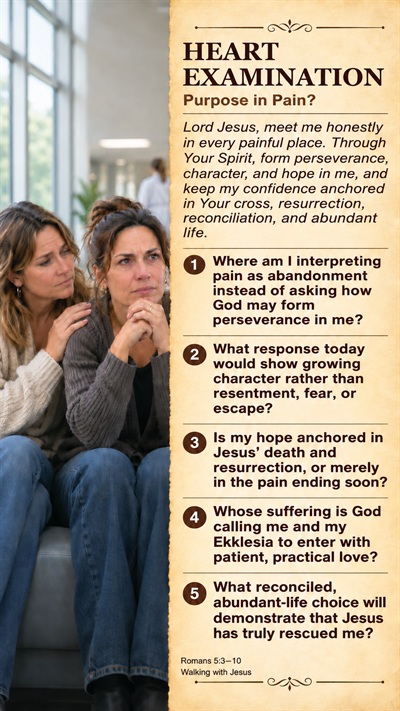
Scroll down for “Lessons Learned…”
LESSONS LEARNED
What if the suffering you would erase is the very place God intends to form perseverance, character, and hope?
Paul does not call pain good; he shows how the Holy Spirit works within suffering while the cross proves the triune God’s rescuing love.
Will we endure pain with faith, receive Christ’s reconciliation, and help the Ekklesia display an abundant life that suffering cannot destroy?
WATCH OUTS
- Do not assume that suffering means God has abandoned you. Pain can obscure God’s nearness, but Scripture calls believers to let endurance mature while the Father lovingly forms His children. (Romans 5:3-5; James 1:2-4; Hebrews 12:5-11)
- Do not romanticize pain or use purpose language to silence wounded people. Biblical hope makes room for grief, presence, shared burdens, and compassionate action rather than shallow explanations. (Psalm 34:18; Galatians 6:2; Romans 12:15)
- Do not separate Christian hope from the death and resurrection of Jesus. Hope is not optimism that circumstances will improve; it rests in the Savior who died for sinners and lives in victory. (Romans 5:6-10; 1 Peter 1:3-5; 1 Corinthians 15:17-20)
SUCCESSES / SPIRITUAL GROWTH
- Let trials become a training ground for perseverance, tested character, and hope. Suffering need not have the final word when the Holy Spirit forms durable faith through patient obedience. (Romans 5:3-5; James 1:3-4; Hebrews 10:35-36)
- Rest in God’s sovereign love when your limited perspective cannot see His larger purpose. Faith refuses to call evil good, yet trusts that no hardship can separate God’s people from His love or defeat His redeeming work. (Romans 8:28; Romans 8:35-39; Genesis 50:20)
- Live as one reconciled to God and made new in Christ. The abundant life Jesus gives is expressed through restored relationship, new loyalties, and participation in God’s ministry of reconciliation. (Romans 5:10; 2 Corinthians 5:17-20; John 10:10)
LEADERSHIP DYNAMICS
- Teach purpose in suffering without minimizing the wound. Wise leaders listen before speaking, sit with people in grief, and refuse quick answers that overlook a person’s actual pain. (Job 2:11-13; Proverbs 18:13; Romans 12:15)
- Keep the whole gospel at the center of care and counsel. The Father’s saving purpose, the Son’s willing sacrifice, and the Spirit’s life-giving work anchor hope more deeply than motivational advice. (Romans 5:6-8; Isaiah 53:10-12; Hebrews 9:14)
- Help people identify faithful next steps while hope is still forming. Encouragement should move from comfort toward endurance, maturity, and concrete obedience without pressuring the hurting to perform. (2 Corinthians 1:3-4; Colossians 1:28-29; Hebrews 6:11-12)
EKKLESIA PERSPECTIVE
- The church must bear suffering together rather than leave people isolated. When one member hurts, the whole body responds with presence, practical care, prayer, and patient companionship. (Galatians 6:2; 1 Corinthians 12:25-26; Hebrews 13:3)
- The church must display the reconciliation Jesus purchased. A community once alienated from God should become living evidence that hostility can end and restored relationships can begin. (Romans 5:9-10; Ephesians 2:13-18; Colossians 1:20-22)
- The church should embody resilient hope before a watching world. Believers testify not by denying pain but by holding to Christ, serving faithfully, and shining with a life the gospel has transformed. (1 Peter 3:15; Philippians 2:14-16; Revelation 12:11)