
“Hard work Trust” (Romans 3:28-30; 4:4,5)
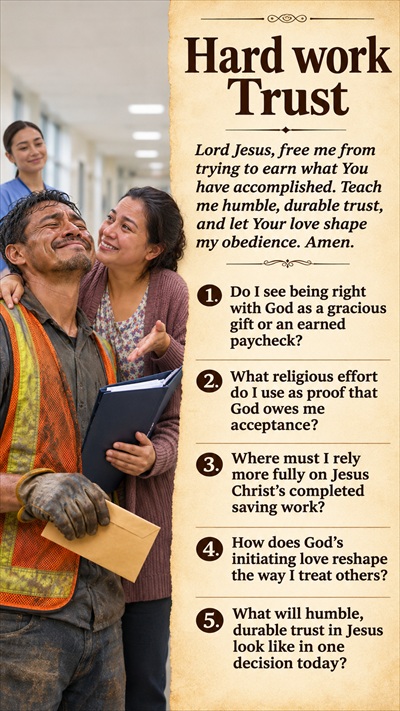
Scroll down for “Lessons Learned…”
If salvation cannot be earned, why do we keep trying to prove ourselves worthy of God’s acceptance?
These 12 biblical principles challenge us to abandon self-reliance, trust completely in the finished work of Jesus Christ, and live out God’s grace through spiritual growth, faithful leadership, and unity in His church.
Can we work hard enough to earn God's acceptance?
Paul's answer is a resounding NO! Salvation is not God's paycheck for religious effort. It is His gift of grace, received through faith in Jesus Christ. Yet genuinely trusting Him can challenge our deepest instincts toward self-reliance.
These 12 lessons challenge us to examine what we're trusting, how we're growing, how we're leading others, and how we're living together as Christ's church.
WATCH OUTS
- Do not turn faith into a wage that obligates God. Paul distinguishes earned payment from credited righteousness: salvation is received by trusting the God who justifies, never by placing God in our debt. (Romans 4:4–5; Ephesians 2:8–9; Titus 3:5–7).
- Do not measure spiritual standing by visible religious effort. Fasting, sacrifice, service, and disciplined activity may express devotion, but none can replace Christ’s saving work or become the basis of justification. (Romans 3:28; Galatians 2:16; Philippians 3:8–9).
- Do not confuse genuine trust with earning salvation by believing. Pastor Doug describes trusting God as hard work because surrendering self-reliance can be costly, while Scripture still insists that grace is not a wage paid for human merit. (Romans 4:5; John 6:28–29; Romans 11:6).
SUCCESSES / SPIRITUAL GROWTH
- Rest your confidence in what Jesus Christ accomplished. His atoning death and victorious resurrection—not our record of achievement—form the finished foundation of forgiveness, new birth, and enduring hope. (Romans 5:6–8; 1 Peter 1:3–5; Hebrews 10:10–14).
- Practice persevering trust when obedience feels risky. Durable faith keeps relying on God’s character and promises when feelings, circumstances, or the desire to prove ourselves press us toward self-reliance. (Romans 3:28–30; Hebrews 10:35–39; 1 Peter 1:6–9).
- Let the Father’s initiating love grow gratitude rather than pride. God loved and acted for powerless sinners before they could rescue themselves, so spiritual growth responds with worship, humility, and love for others. (John 3:16; 1 John 4:9–10; Ephesians 2:4–7).
LEADERSHIP DYNAMICS
- Explain the difference between earning and trusting with ordinary examples. Paul’s contrast between wages and a gift helps leaders expose self-righteousness clearly while still affirming that grace produces a life of obedient service. (Romans 4:4–5; Luke 18:9–14; Ephesians 2:8–10).
- Present the cross and resurrection as the center of the saving message. Christian leadership must direct attention away from religious performance and toward Jesus Christ, who died for sinners and was raised to living hope. (Romans 5:6–8; 1 Corinthians 15:3–4; 1 Peter 1:3–5).
- Help listeners distinguish trusting faith from casual verbal assent. The lesson’s call to durable faith invites honest examination: genuine trust continues in Christ and becomes visible in a responsive life without becoming meritorious payment. (Romans 3:28; John 8:31–32; James 2:17–18).
EKKLESIA PERSPECTIVE
- Welcome Jew and Gentile on the same ground of grace. Because there is one God who justifies through the same faith, the church must reject spiritual privilege and embody the reconciling unity Christ created. (Romans 3:29–30; Galatians 3:26–28; Ephesians 2:13–18).
- Celebrate costly faith without turning sacrifice into spiritual rank. A congregation may honor courageous obedience while remembering that every gift and every standing before God comes through grace, leaving no basis for boasting. (Romans 4:4–5; 1 Corinthians 4:7; Galatians 6:14).
- Teach God’s saving love across generations with Scripture in view. The church strengthens shared faith when it repeatedly tells how the Father gave His Son, loved first, and raised believers into a living and imperishable hope. (John 3:16; 1 John 4:9–10; 1 Peter 1:3–5).