
“Encourager or Judge?” (Romans 2:1-16)
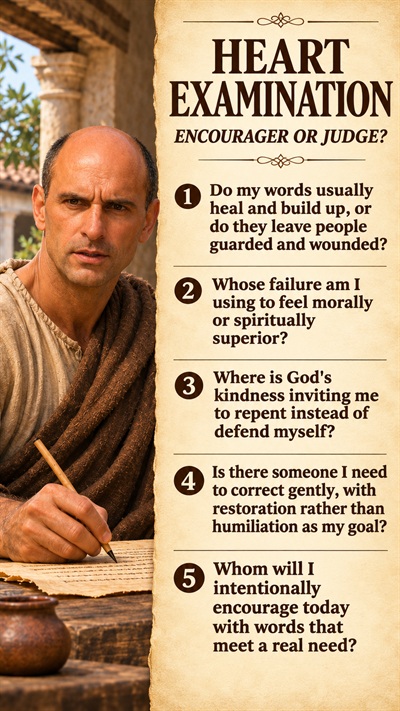
Scroll down for “Lessons Learned…”
What if the greatest damage we do to others comes from words we believe are justified?
We may recognize someone else’s sin, speak the truth, and even defend God’s standards—yet completely miss the pride, harshness, and lack of mercy growing in our own hearts. Jesus calls us to something radically different: truth without contempt, correction without humiliation, and grace that remembers how much we ourselves have been forgiven.
These 12 principles challenge us to examine our words, confront our pride, lead with humility, and become the kind of church where God’s truth restores people instead of crushing them.
WATCH OUTS
- Truthful moral concern can become self-righteous judgment. When we expose another person’s sin to elevate ourselves, we forget that God’s truth first searches our own hearts. Scripture: Romans 2:1-2; Matthew 7:1-5; Galatians 6:1.
- Reckless words wound people beyond the moment in which they are spoken. Criticism, slander, humiliation, and intimidation can pierce the soul and also teach every overhearing listener to fear us. Scripture: Proverbs 12:18; James 3:5-10; Ephesians 4:31.
- Religious progress does not give us authority to despise people still trapped in darkness. Every believer stands by mercy and should remember the old life from which Christ rescued us. Scripture: 2 Corinthians 5:17; Titus 3:3-7; 1 Corinthians 4:7.
SUCCESSES / SPIRITUAL GROWTH
- God’s kindness leads us toward honest repentance. Mercy does not minimize sin; it creates room to turn, receive forgiveness, and learn a God-honoring way of life. Scripture: Romans 2:4; Psalm 103:8-12; 2 Peter 3:9.
- Wise words can bring healing to both the hearer and the room. Encouragement that meets a real need strengthens the person addressed and benefits those who overhear it. Scripture: Ephesians 4:29; Proverbs 16:24; 1 Thessalonians 5:11.
- Remembering who we once were protects humility. Gratitude for Christ’s transforming grace keeps spiritual maturity from turning into boasting. Scripture: 2 Corinthians 5:17; Ephesians 2:1-5; 1 Timothy 1:15-16.
LEADERSHIP DYNAMICS
- Correction should seek restoration rather than humiliation. Faithful leaders confront real harm with gentleness, self-watchfulness, and a clear desire to recover the person. Scripture: Galatians 6:1; 2 Timothy 2:24-26; Hebrews 12:10-11.
- Leaders must submit their own speech to the standard they teach. A ministry of encouragement loses credibility when its private language is cutting, contemptuous, or careless. Scripture: James 3:1-2; Titus 2:7-8; Colossians 4:6.
- Final judgment belongs to the all-knowing God. Human leaders address conduct within their stewardship, but only God knows every secret and repays with perfect justice. Scripture: Romans 2:6,16; Hebrews 4:13; 1 Corinthians 4:5.
EKKLESIA PERSPECTIVE
- The church should be known as a community that builds people up. Congregational speech should make grace audible through encouragement, truthful counsel, and patient restoration. Scripture: Ephesians 4:15-16,29; Hebrews 10:24-25; 1 Corinthians 14:26.
- The church practices moral clarity without contempt. We name sin faithfully while remembering that Christ came to rescue sinners, including us. Scripture: John 1:14; 1 Corinthians 6:9-11; Jude 22-23.
- The church entrusts hidden motives and final outcomes to Jesus. This frees believers to pursue reconciliation, witness, and mercy without pretending to occupy God’s judgment seat. Scripture: Romans 2:16; Romans 14:10-13; 2 Corinthians 5:10-11.