
“Can I Save Myself?” (Romans 3:9-23)
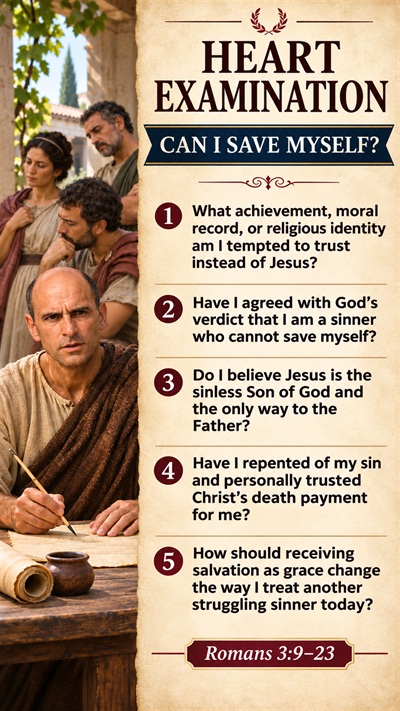
Scroll down for “Lessons Learned…”
What if you stood before a perfectly holy God today—and every good deed you had ever done still wasn’t enough?
Imagine presenting a lifetime of generosity, religious devotion, moral living, and hard work, only to discover that none of it could erase a single sin. That is the devastating truth Paul exposes: we cannot earn the righteousness God requires. But here is the glorious good news! Jesus Christ accomplished what we could never achieve, and God offers His righteousness as a gift to everyone who places their faith in Him.
These 12 principles challenge us to abandon self-righteousness, recognize our desperate need for Jesus, trust completely in His finished work, and become a church that proclaims and demonstrates God’s astonishing grace.
WATCH OUTS
- Good works cannot erase guilt before a holy God. Morality, generosity, and religious participation may benefit others, but they cannot produce the perfection God requires. Scripture: Romans 3:19–20; Isaiah 64:6; Ephesians 2:8–9.
- The law becomes dangerous when we use it to compare rather than confess. God gave His commands to expose sin and silence self-justification, not to build a ladder of superiority. Scripture: Romans 3:19–20; James 2:10; Galatians 3:22–24.
- Vague belief in Jesus is not saving trust. The gospel calls us to acknowledge our bondage, receive Jesus as the sinless Son, and depend on His payment rather than our own record. Scripture: John 3:16–18; John 8:24; Romans 10:9–10.
SUCCESSES / SPIRITUAL GROWTH
- Honest confession prepares the heart to receive grace. Admitting that we cannot save ourselves ends bargaining and turns us toward the Savior God has provided. Scripture: Romans 3:23–24; Luke 18:13–14; 1 John 1:8–9.
- God gives righteousness through faith in Jesus Christ. Salvation rests on Christ’s completed redemption, received by trust, rather than on personal achievement. Scripture: Romans 3:21–24; Philippians 3:8–9; Titus 3:4–7.
- Repentance turns from sin toward the rescuing rule of Jesus. Genuine faith includes a changed mind that entrusts life to Christ and begins walking in His ways. Scripture: Acts 2:38; Acts 20:21; 2 Corinthians 7:10.
LEADERSHIP DYNAMICS
- Leaders must make the bad news clear enough for grace to be understood. If universal guilt is softened, Christ’s cross can sound optional rather than necessary. Scripture: Romans 3:10–20; 1 Corinthians 1:18; Galatians 2:21.
- The gospel must not become a reward for respectable people. Churches should present the same need and the same gracious Savior to every person, regardless of status or history. Scripture: Romans 3:22–24; Acts 10:34–35; James 2:1–4.
- Invite a specific response of repentance and trust. Clear teaching explains what Christ accomplished and calls listeners to rely on Him rather than merely admire the message. Scripture: Mark 1:15; Acts 16:30–31; 2 Corinthians 5:20.
EKKLESIA PERSPECTIVE
- The church gathers as a redeemed people rather than a club of the self-improved. Every believer enters by grace and therefore has no basis for boasting over another. Scripture: Ephesians 2:8–9; 1 Corinthians 1:26–31; Revelation 5:9–10.
- The church proclaims Jesus as the only sufficient Savior. Our public witness joins the universality of sin with the availability of redemption to all who believe. Scripture: John 14:6; Acts 4:12; Romans 1:16.
- The church practices grace because every member lives by grace. Forgiveness, patience, and humble accountability should reflect the mercy we continually receive in Christ. Scripture: Colossians 3:12–13; Galatians 6:1–2; Titus 3:3–7.