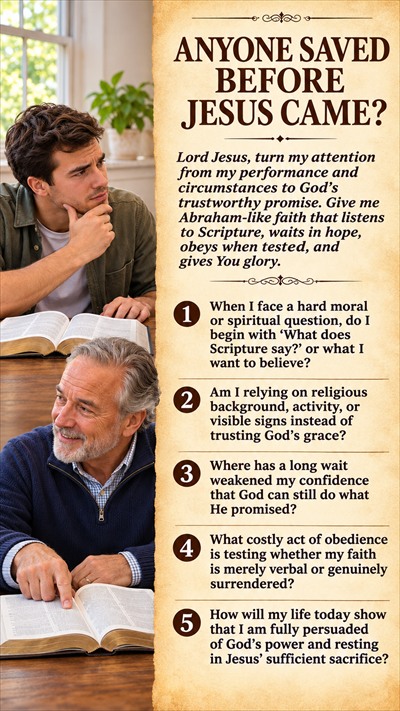
For Friday, November 20, 2026, the lesson “Anyone Saved before Jesus came?” (Romans 4 & Genesis 15) follows Paul’s appeal to Abraham: God credited righteousness in response to faith before circumcision and long before Jesus’ earthly ministry. The lesson calls us to ground truth in Scripture, trust God through long testing, and rest salvation in God’s promise fulfilled through Jesus Christ.
WATCH OUTS
- Do not let changing culture replace the question, ‘What does Scripture say?’ Truth becomes unstable when personal preference or public pressure outranks God’s revealed Word. (Romans 4:3; Isaiah 45:18–19; John 17:17)
- Do not confuse covenant signs with the faith that receives righteousness. Circumcision followed Abraham’s credited righteousness; the outward sign did not create the inward trust. (Romans 4:9–12; Genesis 15:6; Galatians 3:6–7)
- Do not interpret a long wait as proof that God has forgotten His promise. Abraham and Sarah waited decades, and impatience could have displaced the very trust God was forming. (Genesis 12:1–4; Genesis 21:1–5; Hebrews 6:11–15)
SUCCESSES / SPIRITUAL GROWTH
- Strong faith grows by becoming fully persuaded that God can do what He promised. Abraham’s confidence rested in God’s power rather than in favorable circumstances. (Romans 4:18–21; Hebrews 11:8–12; 2 Timothy 1:12)
- Obedient faith keeps moving even when the full outcome is not yet visible. Abraham left home, received covenant signs, and climbed Moriah while trusting God step by step. (Genesis 12:1–4; Genesis 22:6–12; James 2:21–23)
- Saving faith gives God glory instead of claiming human achievement. Righteousness is credited by grace, so the believer’s confidence and praise belong to God. (Romans 4:4–5; Romans 4:20; Ephesians 2:8–9)
LEADERSHIP DYNAMICS
- Faithful leaders anchor difficult questions in Scripture before offering conclusions. Paul models disciplined leadership by asking what God has said and then tracing the biblical evidence. (Romans 4:1–3; Acts 17:11; 2 Timothy 3:16–17)
- Leaders must distinguish God’s promise from the signs that confirm it. That clarity protects people from trusting rituals, heritage, or performance instead of God. (Romans 4:10–12; Colossians 2:11–12; Philippians 3:3–9)
- Mature leadership prepares people for faith that must endure time and testing. Abraham’s story shows that formation often unfolds through delay, repeated promises, and costly obedience. (Genesis 15:1–6; Genesis 22:1–14; 1 Peter 1:6–7)
EKKLESIA PERSPECTIVE
- God’s people across every generation are joined by the same essential trust in God. Abraham becomes the father of all who believe, not merely those who share his physical ancestry. (Romans 4:11–17; Galatians 3:7–9; Galatians 3:26–29)
- The church proclaims one saving righteousness fulfilled through Jesus Christ. People before the cross trusted God’s promise; believers now trust the promised Savior and His sufficient atonement. (Romans 3:21–26; Romans 4:23–25; Hebrews 9:15)
- The church should answer sincere questions with biblical clarity and humble hope. Paul’s argument equips the community to explain salvation without dismissing history, conscience, or honest inquiry. (1 Peter 3:15; Romans 15:4; Colossians 4:5–6)