
LESSONS LEARNED
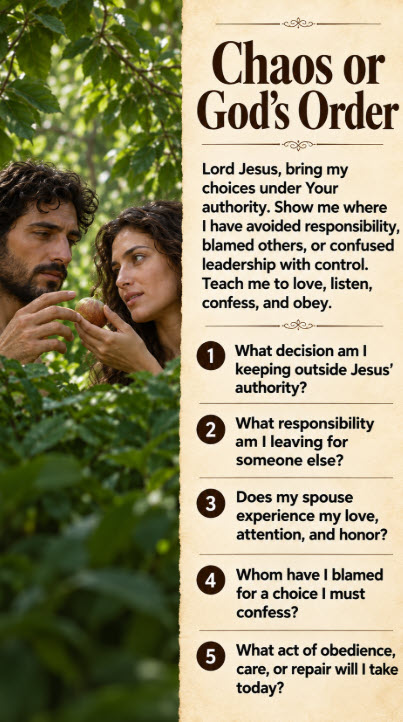
Monday, September 14, 2026 — “Chaos or God’s Order?” (1 Corinthians 11:3). Who shapes the way you use responsibility? Today’s lesson calls us to submit to Christ, honor marriage as partnership, and replace blame or domination with accountable, self-giving love.
WATCH OUTS
- Do not confuse visible power with rightful spiritual authority; every human authority remains accountable to God (1 Corinthians 11:3; Romans 13:1; John 19:11).
- Do not treat rejection of Jesus as freedom from His lordship; all things were made through Him and every knee will bow before Him (Colossians 1:16–17; Philippians 2:9–11).
- Do not turn a husband’s responsibility into domination; husbands are called to sacrificial love and honor, never harshness (Ephesians 5:25–29; Colossians 3:19; 1 Peter 3:7)
SUCCESSES / SPIRITUAL GROWTH
- Bring daily decisions under Jesus, whose creating and sustaining work gives Him rightful supremacy (Colossians 1:15–18; John 1:1–4).
- Receive responsibility as stewardship to practice faithfully, beginning with the people and work entrusted to you (Genesis 2:15; 1 Corinthians 4:2).
- Honor the dignity of both husband and wife; both bear God’s image and belong in a relationship of shared life and care (Genesis 1:27; Genesis 2:18,23–24; 1 Peter 3:7).
LEADERSHIP DYNAMICS
- Lead as someone who answers to Christ; authority is never permission to become the final standard of right and wrong (1 Corinthians 11:3; Romans 14:10–12).
- Make God’s instruction understandable and practice it yourself; guidance loses integrity when the guide ignores it (Deuteronomy 6:6–7; Romans 2:21).
- Treat a spouse as a valued partner, not a servant whose worth depends on compliance (Genesis 2:18,23–24; Ephesians 5:28–29; 1 Peter 3:7).
EKKLESIA PERSPECTIVE
- Gather under Christ’s lordship; the Church belongs to Him rather than to its most forceful personalities (Colossians 1:18; 1 Corinthians 3:5–7).
- Teach order alongside the worth and interdependence of women and men in the Lord (1 Corinthians 11:3,11–12; Genesis 1:27).
- Help households practice love, honor, and responsibility through teaching and accountable examples (Titus 2:2–5; Ephesians 5:21,25).