
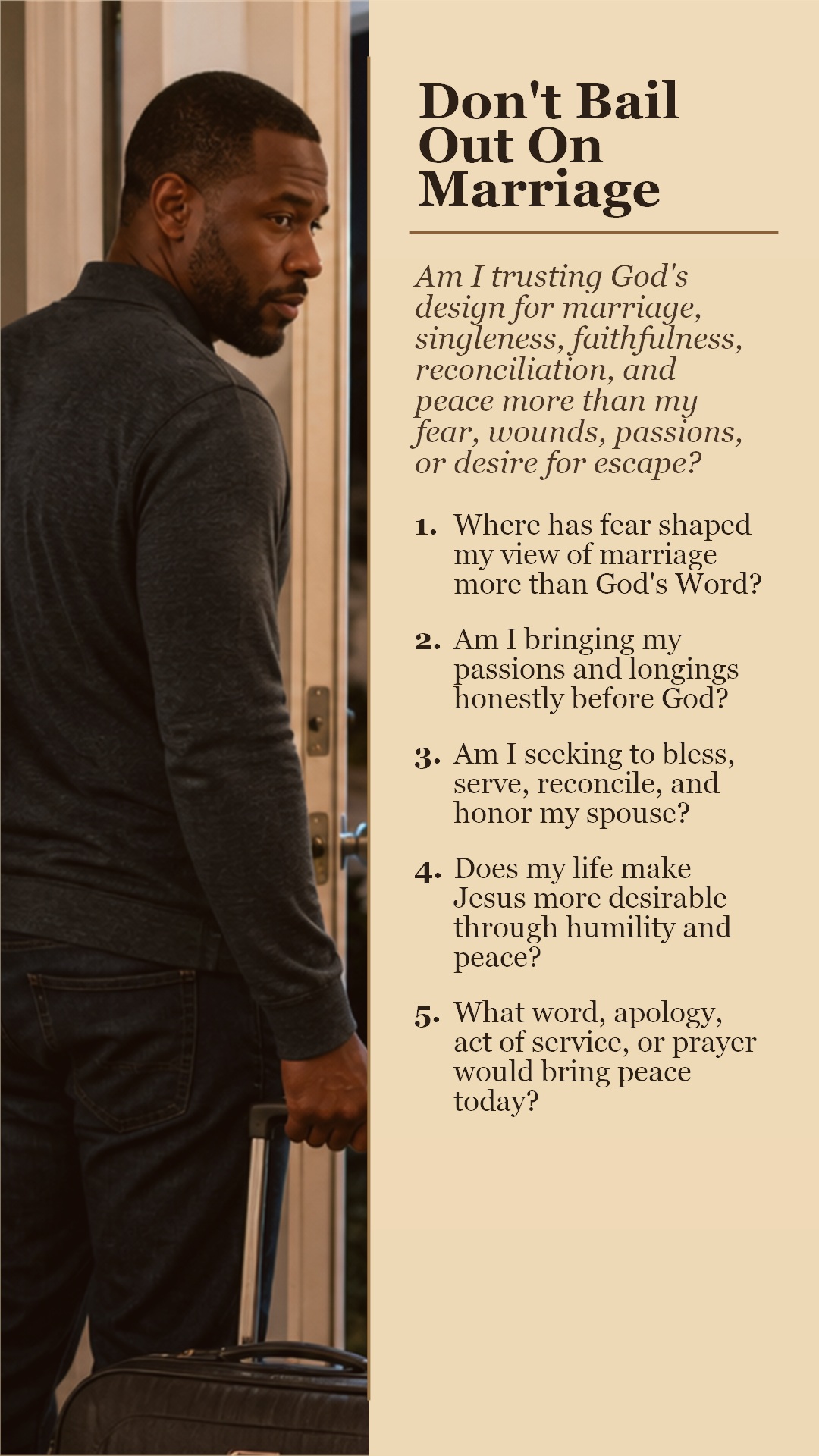
LESSONS LEARNED
Today’s lesson calls us to trust God’s design for marriage, resist fear and escape-seeking, and honor Jesus faithfully even when marriage is difficult or spiritually uneven.
WATCH OUTS
- Do not let heartbreak, family dysfunction, or cultural fear convince you that God’s design for marriage cannot be trusted (Genesis 2:18; 1 Corinthians 7:8-9).
- Do not treat passion as a master to obey; bring desire under the wisdom, self-control, and holy guidance of God (1 Corinthians 7:9; Galatians 5:22-23).
- Do not search Scripture for loopholes when the deeper issue is a wounded, hard, or escape-seeking heart (1 Corinthians 7:10-11; Matthew 19:6).
- Do not assume an unbelieving spouse gives a believer permission to abandon faithfulness, witness, humility, or peace (1 Corinthians 7:12-14).
- Do not confuse biblical peace with selfish avoidance, bitterness, control, or careless disregard for another person’s soul (1 Corinthians 7:15-16; Romans 12:18).
SUCCESSES / SPIRITUAL GROWTH
- Receive God’s compassion for loneliness, heartbreak, desire, and longing without pretending those emotions are simple or small (Genesis 2:18; Psalm 34:18).
- Pursue marriage, singleness, widowhood, or remarriage with honest surrender to God’s wisdom rather than pressure, fear, or lust (1 Corinthians 7:8-9; Proverbs 3:5-6).
- Build marriage as a mutually respectful, God-honoring relationship where each spouse serves the other as a flow of God’s love (Ephesians 5:21; Philippians 2:3-4).
- Stay faithful wherever possible so a Christ-following spouse becomes a living witness of Jesus’ love, patience, holiness, and peace (1 Corinthians 7:12-16; 1 Peter 3:1-2).
- Let Jesus stand at the center of attitudes, words, choices, reconciliation, and daily service until marriage becomes a visible testimony of God’s design (Colossians 3:12-17; 1 Corinthians 7:15).
LEADERSHIP DYNAMICS
- Spiritual leadership speaks honestly about real life without pretense, because the Bible itself addresses passion, heartbreak, loneliness, marriage, divorce, and abandonment (1 Corinthians 7:8-16; 2 Timothy 3:16-17).
- Healthy leadership helps wounded people face fear without dismissing the pain that formed it (Psalm 147:3; Romans 15:1-2).
- Marriage leadership must resist both harsh legalism and careless permission, holding together faithfulness, reconciliation, witness, and peace (1 Corinthians 7:10-16; Micah 6:8).
- The Christ-following spouse leads best by honoring God consistently, not by manipulating, shaming, or forcing belief in the other spouse (1 Corinthians 7:16; 1 Peter 3:15-16).
- Church leaders should teach God’s marriage design with enough tenderness for the wounded and enough courage for those looking for an easy escape (Ephesians 4:15; Acts 20:27).
EKKLESIA PERSPECTIVE
- The Church should be a community where unmarried adults, widows, wounded young adults, and struggling married couples can hear God’s truth with compassion and clarity (1 Corinthians 7:8-16; Romans 12:15).
- Believers must model marriages that show mutual service, safety, honor, peace, and the joy of Jesus at the center (John 13:34-35; Colossians 3:14-15).
- Christian community should help younger generations distinguish the pain of broken families from the goodness of God’s design (Genesis 2:18-24; Psalm 78:4).
- Mixed-belief marriages require a church family that supports faithfulness, witness, and peace without simplifying painful circumstances (1 Corinthians 7:12-16; Galatians 6:2).
- The people of God should be known for protecting covenant faithfulness while also caring wisely for those who have been abandoned or deeply wounded (Malachi 2:15-16; 1 Corinthians 7:15).