
📘 LESSONS LEARNED
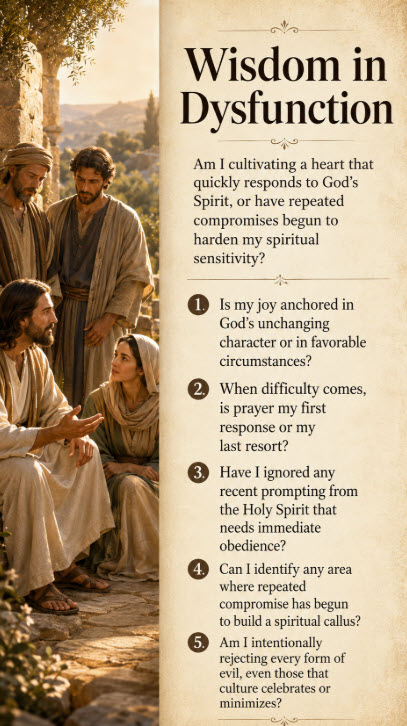
God equips His people to live wisely in a dysfunctional world by choosing joy rooted in His unchanging character, maintaining continual access to Him through prayer, remaining responsive to the Holy Spirit, and rejecting every form of evil.
💥 SINS / FAILURES
- Allowing the corruption and dysfunction of society to steal the joy found in Christ (Philippians 4:4).
- Neglecting continual prayer and attempting to face life’s challenges alone (1 Thessalonians 5:17; Hebrews 4:16).
- Repeatedly resisting the conviction and guidance of the Holy Spirit until spiritual sensitivity grows dull (1 Thessalonians 5:19; Ephesians 4:30).
🏆 SUCCESSES / SPIRITUAL GROWTH
- Choosing rejoicing based upon God’s promises rather than present circumstances (Romans 8:35–39).
- Maintaining continual fellowship with God through prayer during difficult situations (Hebrews 10:19–22).
- Trusting the unchanging character and sovereignty of God in every circumstance (Malachi 3:6).
🧭 LEADERSHIP DYNAMICS
- Godly leaders teach believers how to live faithfully amid cultural dysfunction rather than merely criticizing society (1 Thessalonians 5:14–22; Titus 2:7–8; Philippians 2:14–16).
- Healthy leadership continually points people back to God’s character rather than temporary circumstances (Hebrews 13:7–8; Psalm 46:1–3; Malachi 3:6).
- Wise leaders cultivate sensitivity to the Holy Spirit while warning against gradual spiritual hardening (Ephesians 4:30; Hebrews 3:12–13, 15; Galatians 5:16, 25).
🌍 EKKLESIA (THE CHURCH) PERSPECTIVE
- The local church should be a community marked by joy, prayer, gratitude, and Spirit-led obedience despite living in a broken culture (1 Thessalonians 5:16–22; Colossians 3:15–17; Ephesians 5:18–20).
- Healthy churches encourage believers to remain sensitive to the Holy Spirit’s work instead of drifting toward spiritual callousness (Ephesians 4:30; Hebrews 10:24–25; Hebrews 3:13).
- The Church serves as a visible witness that God’s people can flourish spiritually even in dysfunctional societies (Matthew 5:14–16; Philippians 2:15–16; 1 Peter 2:11–12).